Guide · updated 2026-08-05
Soccer card photo tips: get the shot from the touchline
Soccer never stops for a pose and the field is bigger than your phone. Two decisions — where you stand and where the sun is — fix almost everything.
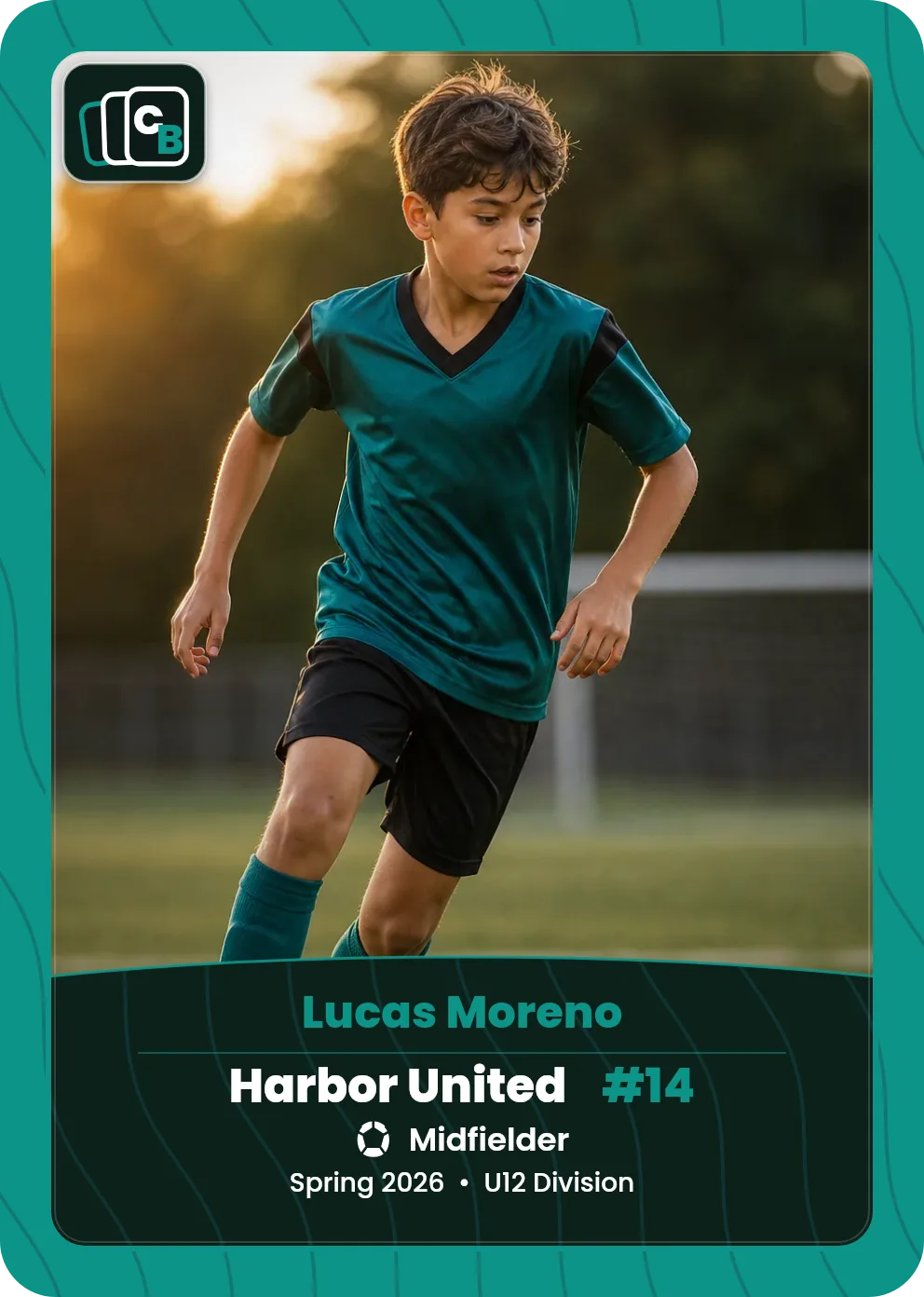
The short answer
The best soccer card photo is a vertical shot taken near the corner flag with the sun behind you, of the player moving toward the camera with the face sharp and eyes visible. Stand at the end your player is attacking rather than at midfield, use continuous focus on the face instead of the ball, and shoot the repeating moments — throw-ins, corners, goal kicks — which bring the player close every few minutes. One good frame per match is enough for a custom soccer card.
Seven steps to a card-worthy photo
- 1
Stand at the corner, not at midfield
Midfield gives you side-on shots of players running past. The corner flag area gives you players moving toward you, which is the angle every real card uses.
- 2
Put the sun behind you
Soccer fields are wide open with no shade, so light direction is the one thing you fully control. With the sun at your back, faces are lit and the sky doesn't blow out.
- 3
Shoot the second half of the match
Late-afternoon and evening kickoffs give softer light, and by the second half you know which end your player is attacking.
- 4
Wait for the repeating moments
Throw-ins, corner kicks, goal kicks, and the walk back to the halfway line after a goal all repeat, and all put the player near the touchline where you're standing.
- 5
Track focus on the face, not the ball
Soccer never stops for a pose, so use continuous focus and keep the point on your player. A sharp face with a blurred ball is a card; the reverse is not.
- 6
Frame vertically with headroom
Turn the phone. Card crops are tall and cut the bottom of the frame, so leave space above the head and keep the player in the upper portion.
- 7
Burst through the moment
Hold the shutter through the strike or the header and pick the frame where both feet are off the ground and the eyes are open.
Five mistakes on the touchline
Shooting from behind the goal
You get the keeper and nothing else. The touchline near the corner is where field players actually come to you.
Standing with the sun in front of you
Backlit players become silhouettes and the phone exposes for the sky. Walk to the other side of the pitch; it costs sixty seconds.
Zooming past 2×
Phone digital zoom falls apart fast, and soccer distances tempt you into it. Crop later instead — a full-resolution wide frame beats a mushy zoomed one.
Waiting for a goal
Goals are rare and unpredictable. Throw-ins happen every two minutes and put your player ten feet away, facing you.
Forgetting the keeper
Keepers are the easiest player to photograph — they stay in one place, and the dive shots are the most dramatic cards on the team.
Other sports: baseball card photo tips · trading card photo tips
Frequently asked questions
What's the best photo for a soccer card?+
A vertical shot from near the corner flag, taken with the sun behind you, of the player moving toward the camera with the face sharp and the eyes visible. Throw-ins and corner kicks bring the player close and repeat all match.
Where should I stand to photograph youth soccer?+
Near the corner flag on the end your player is attacking, with the sun at your back. Midfield gives you side-on running shots; the corner gives you players coming toward the camera, which is the angle real cards use.
Can I take soccer card photos with a phone?+
Yes. Use continuous focus locked on your player, shoot vertically with headroom, avoid digital zoom past about 2×, and shoot bursts. The distances are longer than other sports, so crop in afterward rather than zooming in the moment.
How do I photograph a goalkeeper?+
Keepers are the easiest subject on the pitch — they stay in one area, so you can pre-frame and wait. Shoot from behind the corner of the box during play at the other end, and catch the dive or the distribution.
Do these tips work for other field sports?+
Mostly. Lacrosse and field hockey share the open-field light problem and the same corner-angle logic. For diamond sports, the backstop fence changes everything — see the baseball guide instead.
How much does it cost to make the card afterward?+
Designing is free — you only pay if you order. A Display Card is $20 and a 10-card Card Pack is $35.