Guide · updated 2026-08-05
Baseball card photo tips: how to get the shot from the bleachers
You do not need a long lens or a press pass. You need the right hour, the right side of the fence, and the four moments that repeat every inning.
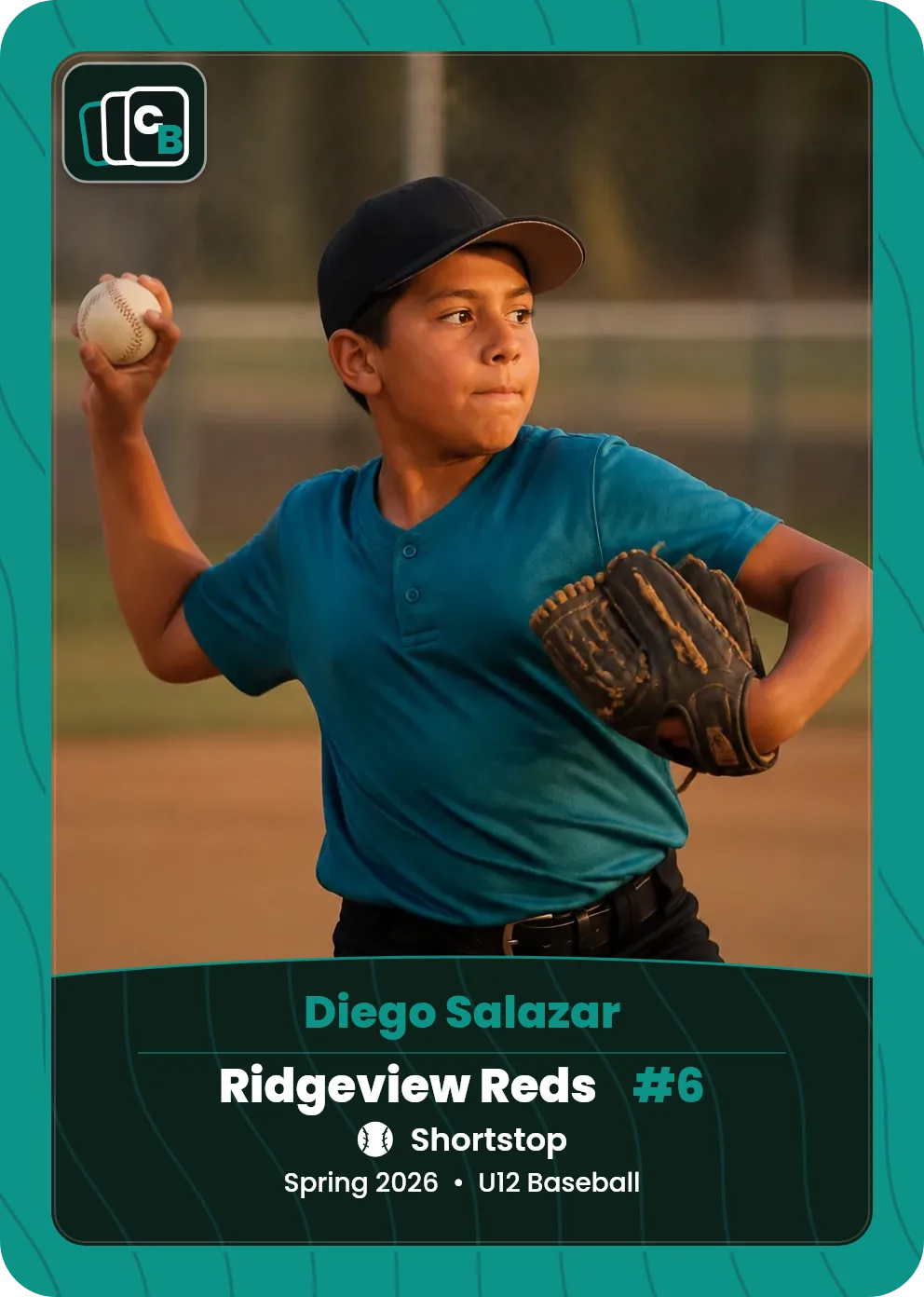
The short answer
The best baseball card photo is a field-level shot of the player's face and shoulders, taken in the last hour of daylight, with the head up and the eyes visible under the hat brim. Shoot from the open end of the dugout rather than through the backstop, lock focus on the face, and use burst mode during the swing or wind-up. One good frame per game is enough to make a custom baseball card.
Six steps to a card-worthy photo
- 1
Shoot in the last hour of daylight
Late-afternoon and evening games give warm, low light that wraps the player instead of casting hat-brim shadow across their eyes. Midday sun is the hardest light on a diamond.
- 2
Get past the fence
Backstop chain-link ruins most parent photos. Move to the open end of the dugout, down the baseline, or shoot through an opening. If you must shoot through the fence, put the lens right against it and zoom in — the mesh blurs away.
- 3
Stand where the repeatable moments happen
You don't need luck; you need position. The batter's stance, the pitcher's wind-up, the throw across the infield, and the walk back to the dugout all repeat every inning.
- 4
Lock focus on the face, not the ball
Tap your player's face on the phone screen before the pitch. Cards are cropped tight, so a sharp face matters far more than a sharp baseball.
- 5
Leave headroom above the helmet
A card crop is tall and narrow and cuts the bottom of the frame. Frame a little wider than feels right so you keep the whole head and shoulders.
- 6
Take burst shots, keep one
Hold the shutter through the swing and pick the frame where the head is up and the eyes are open. One good frame per game is a full season of cards.
Five mistakes that ruin diamond photos
Shooting from the stands
A high angle looks down on the player and makes them small. Get to field level — kneel if you can.
Midday games
Overhead sun puts the brim's shadow straight across the eyes. If you can't change the time, shoot in open shade or wait for the walk back to the dugout.
Chasing the ball
Photos of the ball in the air are not card photos. The player's face is the card.
Zooming with your feet only
Phone digital zoom degrades fast. Walk closer if the field allows it, and crop later instead of zooming past 2×.
Cluttered backgrounds
Parked cars and other parents pull attention. Shift a few steps so the background is grass, fence, or sky.
Shooting other sports? See trading card photo tips. Already have photo day files? Use them for team photo trading cards.
Frequently asked questions
What's the best photo for a baseball card?+
A field-level shot of the player's face and shoulders, taken in late-afternoon light, with the head up and the eyes visible under the brim. Batting stance and wind-up are the two most reliable poses.
Can I use a phone photo for a baseball card?+
Yes — most cards are made from phone photos. Lock focus on the face, avoid digital zoom past about 2×, and shoot a burst so you can pick the sharpest frame.
How do I photograph through the backstop fence?+
Put the lens as close to the chain-link as you can and zoom in slightly. At that distance the mesh falls out of focus and mostly disappears. Better still, shoot from an opening at the end of the dugout.
What time of day is best for baseball photos?+
The last hour before sunset. The light is low and warm, it comes in under the hat brim instead of over it, and it makes dirt and grass look far better than midday sun does.
Do these tips work for softball too?+
Yes — the field, the light, and the repeatable moments are the same. The circle replaces the mound, so position yourself for the release rather than the wind-up.
How much does it cost to make the card afterward?+
Designing is free — you only pay if you order. A Display Card is $20 and a 10-card Card Pack is $35.